Tuesday, 28 May 2013

Ambush at Halfway

After the shock of first combat at Jrinn, the remnants of the Southern Shield who fought there fell back north towards Harl, whilst their commander took the un-blooded remaining Guards towards the unimaginatively named Halfway that sits beside the Harl road more or less about halfway between Jrinn to the south and Harl to the north.


A small settlement of traditional Claive homes enclosed within low walls along the Jrinn-Harl road, Halfway borders extensive woodland that the settlers manage, providing good cover for retreating Guard.

Knowing the only route north to Harl was the track that ran right past Halfway, the Claive had decided to set up an ambush there. The population of the settlement were removed this time to avoid inevitable casualties from what was probably likely to be an intense and close range action. The Southern Shield Commander intended for his Guards to hit the ROF hard at extreme close range with everything they had and then melt away quickly into the woodland before the superior firepower of the invaders could be fully utilised. He wanted to keep his own casualties to a minimum and he knew that the timing of withdrawal of the Guard units would be critical. The Guard units themselves had been issued with Flak jackets as additional protection. Whilst morale was still good, confidence had dropped from high to normal, following the drubbing and high casualty rates of their fellow Guards at Jrinn.

Three Guard units and the Commanders own HQ team were deployed in Halfway itself, all prone behind the walls and buildings of the settlement. No. 6 Guard occupied the blue house, No. 8 Guard the red house, No. 9 Guard the yellow house with HQ Guard in the green house. To anchor his flanks, No. 7 Guard occupied the tree line on the left flank of Halfway where the track led off to the lumber works where most of Halfway's inhabitants worked. No. 10 Guard were deployed within the trees on the right flank of the settlement covering the road to Harl. Each team member had strict instructions to stay behind trees, walls and buildings until ordered to fire so that with luck there would be no heat signatures for the ROF to spot. The plan was to open up on their targets right at the point of the T-junction at the corner of blue house; point blank range.

Having secured the area around Jrinn, TCT Bravo, ROF had assisted in setting up the forward operating base there before climbing into their vehicles and heading out for Harl, closely followed by TCT Charlie. Several small farms and hamlets along the route had been searched and secured without further incident although one of the Ranger scout vehicles had cracked a drive shaft on some hidden rocks whilst running off road. Lt Flode decided to leave them to await the flying mechanics and press on in the hopes of catching the remains of the Southern Shield before it made the safety of Harl, or at least get to Harl before the Shield could dig in. Morale was good and confidence high, and the news from the field hospital was that trooper Prean, badly wounded at Jrinn, was off the danger list.


"Gauntlet" advancing on the road to Harl with Halfway in the distance.


The game was set for a maximum of eight turns as when planning the scenario I envisaged a number of rounds of fighting in alleys.

The battle.

"Gauntlet" was on point; the Guardian class APC of One Section. It's auto-defence MG's were disabled because of the fear of civilian casualties, but as it approached the settlement it's sensors seemed to indicate that there was no one home. A quick check with the boss reaffirmed that the guns would remain on manual fire only.

The Claive were operating on strict "silent routine" until it's commander ordered the ambush sprung. His plan got off to a premature start however when an RPG armed sister from No. 6 Guard let her excitement get the better of her and she fired off a rocket. Seconds later, the RPG's, Assault rifles and SAW's of four Guard units opened up on the APC. Four rockets exploded on "Gauntlet" but it took no damage. Inside it's metal skin, Sergeant Gohl checked his magazine and spoke over the com.
      "Everyone out!".
One section exited smartly with the four trooper right flank team looking to engage the tree line ahead of them and the three trooper left flank team trying to suppress the fire coming in from the buildings.

The volume of fire hitting the APC and the two fire teams was intense and by the start of Turn Three and the arrival of "Gorget" - Three Sections APC, Trooper Zender had been killed and the remaining Troopers of One Section had all taken wounds, with Trooper Hok seriously wounded.

Three Section disgorged from their APC and deployed to their left flank. They discovered the same problem facing One Section: no cover and hard hitting accurate fire from close range. But both sections remain calm, getting wounded away into the back of "Gauntlet" and engaging multiple targets. Fire against No. 7 Guard seriously wounded their commander and 2 others with lighter wounds; the cover of the woodland and the flak jackets helping. Looking vulnerable now, they gathered their wounded and start to withdraw into the deeper tree line. Right flank of One Section attempt to pin them down but failed, although they did hit another Guard before they slipped beyond sight.

Three Section had also taken several wounds at this stage, with Trooper Strat seriously so. Whilst the section medic tries to stabilise her, the rest of Three Section hit No. 8 Guard hard and began to cause casualties. With the fire from the ROF beginning to cause problems, the Claive commander ordered their withdrawal from the red house.


                                                  ROF under fire and fighting back


                              No. 6 Guard moving off the blue house still covered by No. 9 Guard.

Turns 4 and 5 saw the arrival of "Hauberk" with Two section who deployed quickly in front of the stationary "Gauntlet". No. 9 Guard were ordered back from the yellow house and as the fire visibly slackened off, "Gorget's" commander risked a rapid drive forward to park right outside the now empty yellow house. "Hauberk" also charged forward to cover the approach by it's infantry and got a LOS on the retreating No. 6 Guard heading through the alley between the houses. With it's auto defences disabled under orders, the commander lost the initial reaction test. In the fire that followed I think I got the dice rolls wrong but stuck with the outcome which was an RPG round managing to find a weak point in the armour of "Hauberk" which began to brew up. The driver took some shrapnel which pierced his armoured vest, but both he and the APC commander bailed successfully.

                                             
 "Hauberk" brewing in the background. To it's right flank One Section can be seen reaching the tree line of the Claive left flank positions. 

Turns 6 & 7 saw the Claive pretty much get clean away with all their wounded. The Commander and his HQ team were the last to leave Halfway, having failed to find any targets of their own. However, he had seen with grim satisfaction a number of the ROF infantry go down under his Shield's fire and of course, the sight of one of their APC's pouring smoke was most pleasing. Just as he and his team were scrabbling over the back wall of the green house, Three Section were storming the blue and yellow house compounds and Two Section were breaking into the alley between the compounds themselves. No.10 Guard, itching to get involved but under strict orders covered the fall back along the track towards Harl itself.

By the time the ROF had secured Halfway and knew it was empty, the Claive were deep in the woodland. With one vehicle disabled and it's crew attempting to put out the fire and multiple casualties the ROF did not pursue but set up a perimeter defence whilst the CASE-VAC team rushed to their aid.

Conclusion:

After their first bloody mauling at the hands of the ROF, the Claive militia forces at Halfway performed very well indeed. Their commander stuck to the "quick hit ambush and run" plan that he had conceived and pulled back his Guard units just when they needed to. There was a great temptation to leave them in place for one more round to see if they could cause the ROF even more problems but that would almost certainly have allowed the enemy to cause greater harm to his formation, and perhaps even his forces destruction. They managed to pull back before the superior fire power of the ROF could pin them into position.

For the ROF, it was a costly engagement. After the initial two rounds however, they quickly took the initiative and never panicked. Certainly having to debouch from their APC's under intense fire at close range meant that they could do no more than attempt to use suppression fire - all of which failed and it was in these rounds that they took their casualties.

Because it was an encounter engagement without the benefits of their data net support which would under normal circumstances have picked up the deployment of their enemy, they had to overcome the ambush the old-fashioned way. Strung out on the road as they were, they also lacked the fire support that a set piece assault would have given them.

It was not a defeat for the ROF since they had quickly occupied another Claive settlement, but the points and the glory definitely went to the Claive this time round. In addition, the Southern Shield remains a viable force that will be able to add it's strength to the defence of Harl - the first substantial Claive settlement in the valley. The successful ambush of the ROF will also give all Claive forces a real morale boost.

Tuesday, 9 April 2013

There is always hope with a new dawn...

The flicker of light from the screen seemed harsh to the young fighter sat in front of it. The rest of the room was cool and dark and a small persistent voice in his head kept trying to persuade him to turn off the screen and go find a corner in which he could sleep off his exhaustion.

The figure on the screen scared him. Indistinct though the image was, the armour clad torso looked too square and inhuman. The bare head was pale, but the eyes were intense and piercing - even accounting for the poor signal, and the mouth was drawn in a grim un-smiling line. The figure passed a hand over the stubble on his head, the movement blurred.
            "The casualties were far greater than anticipated or needed, brother leader..." the voice said softly, a slight electronic distortion reminding the youth that this transmission was being bounced across hundreds of random relay points to avoid intercept and location detection.
            "Yes sir", he replied, a knot of shame and grief twisted his insides.
            "Most of the dead and wounded were left where they fell." The figure noted.
            "That is correct, sir... The rapidity of the action left me no choice. I had anticipated being able to hold them up well outside Jrinn and under our fire for far longer."
             "Indeed. We had also been of the same opinion."
The youth licked his lips, that were dry and swollen from the forced march and lack of water. Most of their kit had been abandoned at Jrinn. "I made several errors in the placement of the Shield, Sir. Also, I should have been there at the outset to oversee events. My arrival with Number 5 Guard was too late"
              "Your candid assessment is noted, brother leader. Tell me, do you believe your command's arrival with that of an additional Guard would have altered the outcome if you had been able to enter the battle space?" The figures face betrayed no clue or hint for the youth, the voice as soft and calm as if he were enquiring about crop rotation. Yet, the words tore into the youth.
             "Honestly Sir? No. We were less than half a Klick from the fight when I began to realise how bad it was. The sound of gunfire was almost continuous at this point - but little of what I heard was coming from Hunters. We would have arrived just to join the casualty list."
             "I see. So you gave permission for the last Guard who it seems had not fired a shot, to withdraw?"
              "I did, Sir"
              "And why did you do that?"
              "Because to attempt to hold them off any longer would have probably lost our whole force, Sir, fully half my Shield. Aside from the first opening shots, our weapons seemed to have made little impact. As far as I can tell the fire from the Shield was steady and as accurate as it could be under such circumstances, but the volume of fire in reply was terrible..."
              "Hmm..." A hand went up to the chin, held it momentarily and then moved away again.
              "I have failed the Claive, Sir..." the youth blurted out, and he felt the pain of those words and the warm welling of tears in his eyes. The figure on screen said nothing for a long time, regarding him while he sensed the warm tracks of moisture tickle down his dusty face.
              "On the country," the figure said eventually, tiredly. "In fact, it is we who have failed you. We have significantly underestimated the disparity of weapons, armour, training and experience of your Shield against a professional mercenary force. Your command fought bravely, brother leader, and you made the correct decision in the field." Another long pause whilst the youth absorbed what he was being told.
              "You did well, brother. You and your Shield."
              The youth almost gasped. He had expected... well, he wasn't actually sure what he expected. Banishment probably, for failure. For a while, the two regarded each other; one a newly blooded survivor of modern combat, the other a grizzled refugee from Inter-Stellar wars more terrible than the youth could possibly conceive.
              "What would you have me do now Sir?" the youth asked. The was a smile from the screen. Brief but with some warmth.
              "I fear I must ask you to take up the fight again brother leader."
              "Of course Sir! For Harl?"
              "For Harl, yes. But not at Harl yet. You are now at Halfway, yes?"
              "Yes Sir, I arrived about half an hour ago and the rest of the Shield are two clicks away."
              "Good. I think we should be able to engineer a little reception for the ROF at Halfway. And I fear we will have to commit our Hammer much sooner in this fight than we had hoped for."
               "The Hammer will smash them sir!" the youth exclaimed, and the exhaustion and grief for his lost friends was momentarily washed away by the thought. The figure on screen nodded sadly.
               "Perhaps it will at that. For a little while. But I fear that even the Hammer may yet crack ere we have accounted for all of them..."

Friday, 5 April 2013

Sharp Action at Jrinn

Although certainly a Claive holding, Jrinn was really nothing more than a run down trading post on the southern extremity of the Sarl Valley (Map ref. C10).

Knowing any incursion by the ROF was likely to come through Jrinn, the Commander of the Claive's Southern Shield had placed four Guards there, with an additional Guard and his own command team close by. The remaining elements of the Shield were to the North East at Signal (Map ref. J11), as this settlement straddled a cross roads that provided the only other viable route into the valley from Arden. Claive central command hoped that once the key line of advance was established, the Southern and Central Shields could combine to provide a stiff defensive line against the incursion.

ROF Objective. 

Having been granted the honour of leading the campaign, Lieutenant Flode commanding TCT Bravo was required to simply secure Jrinn, push out beyond it for about a Klick and so establish the first Forward Operating Base for the ROF in the Sarl. The two key elements for success would be absolutely NO civilian casualties and few, if any ROF casualties at this early stage and certainly no loss of AFV's.

Having reviewed the ground ahead at their start line positions, and seen with her own eyes the number of heat signatures and probable weapon profiles coming in from the teams sensor arrays, Flode decided against deploying the APC's. The ground over which they had to advance was narrow and the range short. The ROF knew the Claive was well equipped with old but reliable anti-armour. Flode hoped that the APC's would not need to be deployed but they remained waiting on the start line if required.

She decided on simplicity in the end, trusting to the better training, equipment and experience of her team. They would deploy abreast and assault Jrinn in a three phase operation. Swift action and heavily armed troopers would, she expected, win the day. They would be backed up by the support weapons of the STING mobile GPMG team.

Claive Objective. 

Jrinn was to be a short holding action only. The trading post was only symbolically important as the first part of Claive territory but was otherwise irrelevant. The Claive central command needed to see the ROF in action and if the Claive Guards could inflict a significant casualty count against the ROF at this early stage, it might give them pause for thought about the merits of the contract with Arden. Better still if an AFV or two could be destroyed...

So, the Southern Shield Guards should be prepared to open fire swiftly but retire from Jrinn before any serious casualties of their own were suffered. Whilst casualties were inevitable, the integrity and strength of the Shield needed to be preserved for the defence of Harl and if necessary, Farrow and beyond.

The battlefield laid out as viewed from ROF positions.

The initial deployment positions as viewed from Claive side.

The action.

The battle was to last four turns so as to make the ROF think about the need to get moving quickly. The rules were Tomorrow's War from Ambush Alley and Osprey and this was my "first go" at seeing how they played.

The ROF deployed the TCT Bravo of three sections of seven or eight troopers armed with Tech Level 2 Assault Rifles. Each section had a SAW, a team sniper and a SLAM (RPG). In addition, from round two, the TCT Bravo HQ team and the STING support team of three mobile GPMG's would be on hand to provide fire support and a small reserve of firepower. The ROF are equipped with Light Armour, and although no NET was available, each team member has good sensory availability as part of their helmet and comms array relayed through their APC's and the HQ Command team vehicle. Morale began as good and confidence was high.

The Claive deployed 4 Guard Teams in and around the trading post. An additional Guard plus the Southern Shield Command team are en route and are likely to arrive at Turn 2 or 3. The Claive are Tech Level 1 and have no additional armour being a lightly equipped militia force mainly used to fending off Kresh raids and gangs from the wastes. Each Guard unit is 9 or 10 strong with a Guard Leader and are equipped with Assault rifles and at least one SAW and RPG. Many of the teams have 2 of each. Morale also began as good and confidence similarly high.

Turn one saw the ROF's Two and Three Sections move forward to get into and beyond the cover of the small copse of trees whilst on the ROF left flank, One Section would try and keep Claive Heads down. The first few actions in this first turn might have presaged some startling events. Guard No. 1 who were in and around the building below the Trading Post proper beat Two Section on the first reaction test and in the subsequent fire fight killed Trooper Ik-Lak and seriously wounded Trooper Imray. An audible gasp could be heard on the TCT Bravo's comms links.

However, after that first blooding by the stalwart Claive Guards, it quickly deteriorated for them, and helped illustrate for me one of the key mechanisms of these rules: the tech levels. The ROF were rolling D8's, the Claive D6. The Claive lost dice because of it and clearly had less chance of rolling higher scores against the ROF dice. So, despite some early good dice rolls after that initial exchange, the superior firepower of the ROF quickly established ascendancy over the Claive Guard, and they were punished for their lack of armour.

The Claive plan for swift exchanges of fire and withdrawal started to go wrong almost immediately. No. 1 Guard, after it's first success took a hammering from both Section Two and One and got pinned. The attempt by No. 3 and 4 Guard to intervene and interfere with the ROF advance was beaten by better reaction test rolls and superior fire power of the ROF.

I think the final fatal mistake of the Claive commander at the end of Turn One was the inactivity of No. 2 Guard whose position meant that they had no LOS on any ROF troops during Turn One. Instead of re-deploying, they stayed put to be in a position to engage next Turn.

The start of Turn two saw one of the three civilians present on the battlefield decide enough was enough. The remaining two passed their morale tests and kept their nerve thus preventing some of the ROF units from firing on elements of the Shield - particularly No. 2 Guard. However, the third civilian making an unsurprising bolt for it, uncovered No. 3 Guard to the guns of both Two and Three Sections.

At this stage, the ROF were still concerned, particularly for Two Section who had been fired on repeatedly throughout Turn One by the guns and rockets of three Guard units. Given the weight of fire and the proximity of the enemy, they appeared lucky to have sustained only two casualties. However their number was reduced by one more trooper as the section medic (one of the attributes of TCT Bravo is that each section has a medic) dragged off Trooper Imray to the rear for urgent CASEVAC.

All teams moved forward and in the ensuring series of firefights No.'s 1, 3 and 4 Guards were effectively wiped out. Again, they were lucky with many of the casualty roles but so much fire was poured onto them, multiple hits turned light wounds into serious ones and they were unlucky with the loss of SAW's and RPG's. Although the ROF did not know it yet, by the end of Turn Two, the action was effectively over.

The Claive commander, himself about to join the fight with his team and the reinforcement of No. 5 Guard had to make a swift but brutal decision. He had lost radio contact with all but No. 2 Guard whose slightly hysterical leader was telling him all the other teams were dead, or down. If so, this was already a profound disaster for his Shield, and to compound that with the loss of further Guard could not be justified for the orders he had. But to leave the battlefield with so many Guard unaccounted for was almost as bad. With the leader of No.2 Guard emphatic about his inability to reach any wounded from the other Guard teams (he was right), the Shield commander reluctantly ordered the withdrawal of No. 2 Guard and he and No. 5 Guard covered their withdrawal (off table).

Turn Three then saw the ROF continue to advance. One Section assaulted the positions of No. 1 Guard to find all there dead or badly wounded. No fire came from above either. In the sudden silence across the Trading settlement, Trooper Hok from his position on the left flank with One Section was heard by the whole TCT via the comms to say: "That's it, they've broken. Looks like we've hit most of 'em any ways..."


Trooper Hok of One Section, TCT Bravo, Seven Valleys Battle Group, ROF, in action at Jrinn.

The campaign (finally) gets underway


The Guardian “Hauberk” locked brakes and came to a gentle halt thirty meters from the crest of the rise it had ground up for the last few minutes. Grey dust from the rough road plumed around it’s armoured wheels and drifted lazily westward on a gentle breeze. On the front flanks of the carrier, the two defensive machine guns gittered left and right seeking threats, whilst the roar of the engine descended into a low growl as the driver idled  his vehicle. 

On top of the APC the hatches hissed alive and opened upward and forward, clicking softly into lock, and from each hatch opening swarmed an armoured fighter who slid quickly and efficiently over the side of the Hauberk and onto their bellies, then rolled away from the vehicle into the short turf either side of the road in a move that looked synchronised, very well rehearsed and almost poetic. The speed and timing in which a combat squad exited it’s armoured personnel carrier and deployed was often literally, a matter of life and death. 

The eight members of the team, four left and four right were in a defensive cluster, their weapons pointed from nine through to three o’clock. All had visors down and weapons  sweeping their arc of the defence, and for each, as this was an experienced team, it was as involuntary as breathing.  Each team member had the gentle and reassuring murmur of the team communication chatter in one ear whilst the other was being fed the sounds of the rest of the world around them enhanced through their comm helmets and overseen by the comms control system in Hauberk which was also listening out for anything that might sound like the noise of a threat in close proximity to the team and the vehicle. 

The lead figure on the left flank moved - leaping up and bent double sprinting forward to just before the crest of the little hill, followed almost immediately by the lead figure of the right flank who threw themselves down in the dust close by the first fighter. For some moments neither said anything, but the side to side movement of their helmeted heads indicated their close scan of the land lying ahead of their position.

“Well Jarl,”, the first figure said finally, her quiet words picked up on her mike and communicated via her helmet comm. to her number 2. “The Sarl valley starts just over there.”
Jarl grunted, his visor scope was set to 3x magnification and he tapped on his wrist pad to increase this vision up to 10x. The road which was really no more than a dusty track snaked down the other side of the rise and pushed on through the low lying ground for half a click before rising steadily, gently up a larger hill. On top of the hill lay the trading post of Jrinn - typical builds in the Claive style and surrounded by low walls to keep the local scavenger beasts at bay - and probably helpful as cover when who ever pulled the triggers fired on the Arden security team that had been sent to formally serve notice to quit. A third building lay just below the hill, along with more walling. All looked quiet. Jarl flicked the rocker switch on his wrist pad and his visors view switched colour - transforming the landscape to shades of grey. Amongst the buildings on the hill were a number of clear blurs of white - human blobs of pale light against the grey. Apparently unarmed.
“We have a welcoming committee, any way, Sann.” Jarl observed. 
“To be expected. This is their home. I track three groups just inside the compounds - none look like they are carrying.”
“Roger that, boss.” 
“All. Bravo Two to Bravo Lead. Target in visual. Multiple confirmed locals. No heat. Do we go?” Sann had patched through to the team leader back in “the Boss” but had included everyone in the team because there was nothing of note to report which would be good news for all to hear.”
“Affirmative Bravo Two. Let’s take a stroll with our dogs.”
“Roger that Lead.”
Senn looked to her right at Jarl. His face from nose up was invisible behind the visor of his helmet but his mouth, surrounded by a day of stubble pulled a side ways scowl that he always used when he meant “lets get this done” when he would rather be in a canteen somewhere instead - the job having been done. 
Senn stood up, Jarl close behind. Both knew that their bodies now stood stark on the skyline for those watching in the hamlet ahead. If there was a sniper there who had not yet been picked by their sensors then the first they would know about it was if their body took a shot. The familiar feeling of naked vulnerability mixed with fear of death or maiming shivered through both mercenaries. Behind them they knew that the rest of their team had stood and would be walking steadily forward, weapons raised, scopes trained on five different potential locations where death might be lurking. The roar of Hauberk’s engines roared as her driver edged her forward. 
On the comm, Senn heard Lieutenant Flode confirm to battle group:
“Seven this is Bravo One. Target Juliette One ahead. We are taking a stroll with the dogs.”
“Roger that Bravo One.” came the dispassionate reply from signals operator further back down the road with the Battle Group HQ group. Corporal Senn and her Two section advanced slowly forward with their Guardian class Armoured Personnel Carrier following at the same pace a little behind them. To their rear on either side the other two fire teams would be doing the same - taking a stroll with their “dog”. Behind them would follow the other HQ led elements of Tactical Combat Team Bravo, and behind them the rest of the Seven Valleys Battle Group. 
The Rapid Offensive Force was on the march into the Sarl Valley. It would take some stopping. 

Degraded intercept signal partly retrieved unknown source


++++extract broadcast 113476971 linear GAPC “Heater” TCT Charlie SVBG ROF outpost Kilo Six++++++

......”I am sorry I am not with you for this first blooding against the ROF but we must conserve the strength of the Hammer’s swing for a decisive blow. Your task must...(lost data)....important to remember that a building even if it is your home is not...(lost data)...trate our force when the axis of advance is certain. Brothers and sisters of the South Shield I urge you to remain calm, hold your position as ordered but be ready to w...(lost data)...of you. The ROF are not our enemies. They are carrying out a role for which they have been paid. A ro...(lost data)...significant loss will...(lost data)...return to negotiation...(lost data)...Arden...(lost data)...prayer, courage, forti...(lost data)...hearts...(lost data)...our word and our belief will be translated into our guns and missiles for this sacred work. I shall be with you...(lost data)....

++++extract ends++++

ROF gets it's marching orders...


++To: Colonel Jeb Gull Olam, Commander, Combat Command “Black Anvil” 
From: ROF Central Command, Jelab, Gaop Ridge. 
Subject: Arden contract for Police Action in Sarl Valley. 

Colonel,

Your CC will deploy for PA in Sarl Valley with immediate effect. 
Be advised that the contract allows for clause 23c, part 4a should ROF deem this necessary on evidence provided by your progress. CC’s “Storm Force” and “Jagged Edge”  will be on stand by to this end, in which case HQ element “Iron Blade” will be deployed to co-ordinate with CC “Black Anvil” taking lead role. 

The PA is planned in four phases with considerable flexibility for local judgement on the ground. The summary of the phases is attached. 

Points of note:

ROF forces will be contractually bound by article ZT4709-B during the entirety of this PA. Your attention is drawn to appendix A which details the rules of engagement. In summary, there will be no net coverage, no air support save for medical case-vac, no substantial artillery support and very limited armour support, save for organic TCT and BG elements and even these have severe restrictions imposed on them. 

Civilian loss of life and infrastructure damage will be coded into the contract. 

Severe loss or damage to above could cause ROF to breach contract but will also be in contempt of world court. 

You will be personally liable also, as commander on the ground.

The attached intel report provides all current data on Claive forces and structure.

We expect a brittle enemy. They will be fierce and determined at all times. You can and should expect an insurgency response from the civilian population, almost all of whom at some point have been Shield members. 

However, with fast and fierce engagement and even faster maneuvering, once the shield is pierced, we believe it will crack. 

Conference protocols will be maintained daily. Key decision will remain the need to utilise 23c/4a should this become necessary. 

Supply will be by road only in Sarl, although river supply should be considered if viable. 

Any intel on “Hammer” will be provided as soon as it arrives. At present, you may be best placed to learn more of this element on the ground from local knowledge. 

Good luck, Colonel. 

Signal ends.++

Friday, 1 June 2012

Campaign Map of the Sarl Valley

This is the map I am using for the Campaign.
Any similarity to a certain Valley during Jackson's epic march and fight and march campaign is purly deliberate....

Wednesday, 29 February 2012

ROF Intelligence assessment of the upcoming Police Action

Intel Report PA12076/Arden.
Summary of geographic, political and military assessments of the Claive and the Sarl valley. 
For board of ROF eyes only. 
Sarl Valley is nestled on a roughly NE to SW orientation between the Sarl Mountains to the  East and the Rabon Mountains to the West, comprising rough highland and valley features  about 23 clicks wide by 35 clicks long. The river Sarl flows North through the valley, formed from two forks that join beyond Mount Farrow. The South Fork flows past the eastern flanks of Mount Marred from springs and mountain streams in the Sarl Mountains  that flow together to form the start of the South Fork two clicks west of Harl. The North Fork flows from springs 5 clicks east of an area between Breemolt and Carron Hill. 
The previous rough road net that ran through the valley has been considerably added to by the Claive over its lease in the valley. There are five routes into the Sarl from gaps east in the Rabon mountains, and two from the West and the Sarl mountains. Two main roads north from Arden lead into the Sarl, with one road leading North out of the Sarl into the wastelands of the former Deal protectorate. There are 5 river crossing points. 
Twelve principal settlements feature in the valley with Harl, Brand, Carron, Hanolt and Farrow the largest or with most importance. The key settlement is Farrow where the leaders of the movement are based. 
In addition to these main settlements there are numerous small farms and individual households scattered all through the valley, mostly along the road nets. Estimates of population is based on satellite tracking of body heat signatures during the assessment period. It would seem that around 20000 individuals are settled in the valley and most will be members of the Claive. 
Claive industry is mostly farming within the fertile valley itself. A small mining operation in the heights of Marred yields small levels of ores and minerals which nevertheless provides a considerable additional income. 
An estimate of Claive income is difficult to determine, but the record of transactions on produce and livestock sold and the mining operation allow a reasonable operating profit of some 20 million. There has been no time available to track investments but it would appear the Claive do have several investment advisors. 
Most trackable purchases are standard consumables and equipment. Energy is mostly self generated from solar and wind systems. 
The Claive hierarchy is not clearly understood. The original application to settle in Sarl came from a group of twenty elders who had formed the Claive and when they moved into the Valley they took with them around 1500 followers and set up their first centre in what became Carron Hill. 
The Claive social structure is based around regional hubs. Local settlements have elders who provide guidance on living, working, business, everything, who in turn report to the central elder council. Law and order is very good. 
A militia system has been in place since the Claive first located to the Sarl. The need to protect themselves from local banditry and especially from raids by the Kresh required a form of para military security. The first militia were volunteers but in time a system of obligatory service was introduced so that all Claive members between 18-30 did a stint in the militia which was named, and remains, the Shield.
The core element of the Shield is the Guard - a unit of up to 10 fighters under a Guard Leader. Each Guard unit is a local group who answer to the local Shield - the basic commanded structure of the Claive forces. A Shield is a regional militia force made up of several Guards who operate in their local area providing security to settlements, patrols and any military response required to protect them. A Shield is commanded by a local elder. Several such Shields in a region are formed into Fighting Groups which provide the Claive with a tactical force to combat more serious security issues and incursions. It appears that Fighting Group commanders receive some form of officer training from a central source. 
Equipment is standardised in Guard units with a basic uniform (un-armoured) and the elderly but still useful Hunter T3 Assault rifle. The Hunter T4 SAW supports the Guard. They appear to have quantities of hand held rocket propelled launchers capable of anti personnel and anti armour munitions. We suspect they utilise these to clear Kresh camps and to destroy the caravans of bandit raiders over the Rabon Mountains. These weapons are likely to be Badlin Industries MK II designs - with limited but effective target acquisition systems and capable of penetrating AFV armour. 
Claive units are well motivated but training and experience varies considerably. It is likely that against a trained force, the Claive Shields would not stand. Their only chance of success would be in concentration of force against numerically inferior numbers, ambush and counter insurgency. Substantial casualties to the Shields would likely cause the disintegration of the system. 
Initial reports estimates 12 Shields in three or four fighting groups based on regional lines. There are no indications of AFV or substantial artillery support. 
There are local reports from survivors of bandit groups, and some even less substantive reports from Kresh sources of an additional fighting group known to the Claive as the Hammer. This small combat group is alleged to be well armed, equipped, trained and motivated, but there are no cohesive reports or any substantial evidence of such a unit. It is possible that they have made use of a mercenary unit or perhaps hired deserters from other forces. 
Claive religious doctrine is based on the principal of shared community participation whilst waiting for the coming of an event predicted by the original elder. The community is respectful of it’s members and it’s neighbors, deals fairly with suppliers and customers, appears to have a respectful interaction with it’s environment and appears to genuinely believe in its codex. Whilst peaceful, the Claive have no issue with defending their people, homes and lands, and this seems to have been highly successful over the years. Little has been heard of the Kresh or banditry in the Northern Marches of Arden for a generation. The raiding season of the past always brought trouble to the farms and vineyards of North Arden. ROF forces should be under no illusion that initial resistance from the whole community will be stiff. The restrictions of the mandate under which our forces will operate in the valley will put our forces at a considerable disadvantage, being unable to utilise extensive armour, artillery and air support, severe restrictions on combat in built up areas and where civilians are in proximity. 
However, in summary, it is the judgement of this report that once the Claive shields have been engaged and bloodied over several engagements, ROF forces will be able to dominate. In particular, it will be important to make use of rapid movement to outflank and encircle Shield forces. 
Report ends.

Sunday, 26 February 2012

The Kresh go...well sort of monk-ish!


Did two quick paint tests today. Happy with the overall scheme although Macro pictures really do show how rushed a paint job they were! Since the Khurasan Chewks are clearly crustacean in biology, I decided on Astronomican Grey skin - a nod to Lobsters and Shrimp types. The robes I decided on Tausept Ochre with Graveyard Earth belt and pouch. The Rifle is in Adeptus Battlegrey with Dark Angels Green muzzle for a little colour variety. Last minute, I made the eyes (or short stalks) Gore Red. As you can probably tell all GW paints. At normal vision, the robes do have a monk feel to them, but that's OK. Aside from doing the usual cover to bases, they should be relatively straight forward to paint! Now where's that time to do them gone..? I also thought if there is anyone looking for sci-fi Goblins for any reason - these little guys would suit! Very night-runner-esque.

Saturday, 25 February 2012

The Kresh are gathering...

Made a start on the Kresh today. Basing and undercoat is all I have managed so far! The Kresh (Khurasan's mighty Chewks to you) are the indigenous sapient species of Sytol. Over the thousands of years that the planet has been colonised by humans they have slowly dwindled in numbers and range although it is believed that their natural habitat has always been the deserts and wastelands of the central continent. The Kresh are raiders - diminutive is size compared to humans but brave in battle, and usually armed to the teeth (or hardened lip) with heavy weapons to help overcome a foe. All their weaponry is to their own design and manufacture. A typical Kresh raiding band will appear almost from nowhere, saturate the target with heavy automatic fire, mortar rounds and HE rockets whilst the assault teams rush in from close range. They will raid anything and anyone they feel they can overwhelm without excessive casualties (including amongst themselves) and the clear objective is always plunder they can take away and trade or reuse. Still thinking about colour schemes and especially their skin colour but I think Yellow will be an important colour to the Kresh in their belief system and so should figure prominently.

Saturday, 18 February 2012

Been busy....

I have managed at long last to devote some time and effort to getting the forces ready for the Sarl Valley campaign. The ROF are all based, as are their AFV support. Today, I completed the basing of all the initial forces. Funny, I used to be very impatient of painting and basing in particular but as this project progresses, I find I have actually enjoyed the process. Quite therapeutic. I have learned that it pays to spend a little time on the basing. I am not a great paint-smith but some of the recent units are not too bad, and a uniform basing colour and process helps bind the campaign together. So as of this evening I have the ROF, the Claive militia forces and civilian population, some of their homes, as well as some of the other characters who will become embroiled in this little police action. I posted some shots of the ROF, Claive Shield and Claive Civilians earlier; below are some additional shots of the first wave of forces.

 Arden Royal Police.
These volunteers from Arden's royal civic law enforcement will follow in the wake of the ROF and provide law and order in the Sarl Valley as the pacification progresses. 
(GZG security troops painted up in the Arden Royal colours)

 Bulldog class Command Vehicle - this one is "The Boss"; the command vehicle of Lt Durrow Monde Flode of Tactical Team Bravo, Seven Valley's Battle Group of the ROF who have been tasked with implementing the court judgement on the Claive. 
(GZG AFV)

 A Guardian Class LP (low profile) APC - this one is "Gauntlet" - the "dog" of Fire Team One of TCT Bravo. 
(GZG AFV)

 "The Beast" - Beatle Class LP (Low Profile) MBT. The ROF prefer the robust all terrain six wheel AFV's of Clash Industries over tracked vehicles, and they are less expensive and easier to maintain than hovers or anti-grav. Each Battle Group has organic tank support, but in the Sarl campaign they could only be deployed if the ROF run into serious opposition - something that is not expected. 
(Another excellent GZG AFV)

 Claive settlement. 
This is typical of the traditionalist Claive build of the adobe style. The Claive live simple lives but colour is of import in their belief and so their homes are usually painted in bright colours. Despite the traditional build, each settlement is fitted out with air-con, full satellite communications and high level security doors. Whilst the Sarl is an idyllic looking land, there are enemies all around it and the Calive have no illusions of the need for security. 
(Kerr & KIng Adobe building with GZG accessories) 


 Closer view of the blue house with Claive Sister off to work.


Most Claive homes have a small walled garden.

 
This partial transmit ion was intercepted by the ROF as part of their intelligence sweep of the Sarl on the award of the contract. After extensive data recovery and enhancement, this image - still blurry - seems to show well armed and equipped troops in a pattern of armour that looks similar to the old Union Mark VI pattern. They are clearly stood in front of a wall that is typical of Claive structures in the Sarl Valley, but ROF intelligence teams have been unable to establish the identity of these soldiers. They fit no know FFA or mercenary forces on Sytol. 
(Khurasan Federal troops)

Meet (some) of the cast...

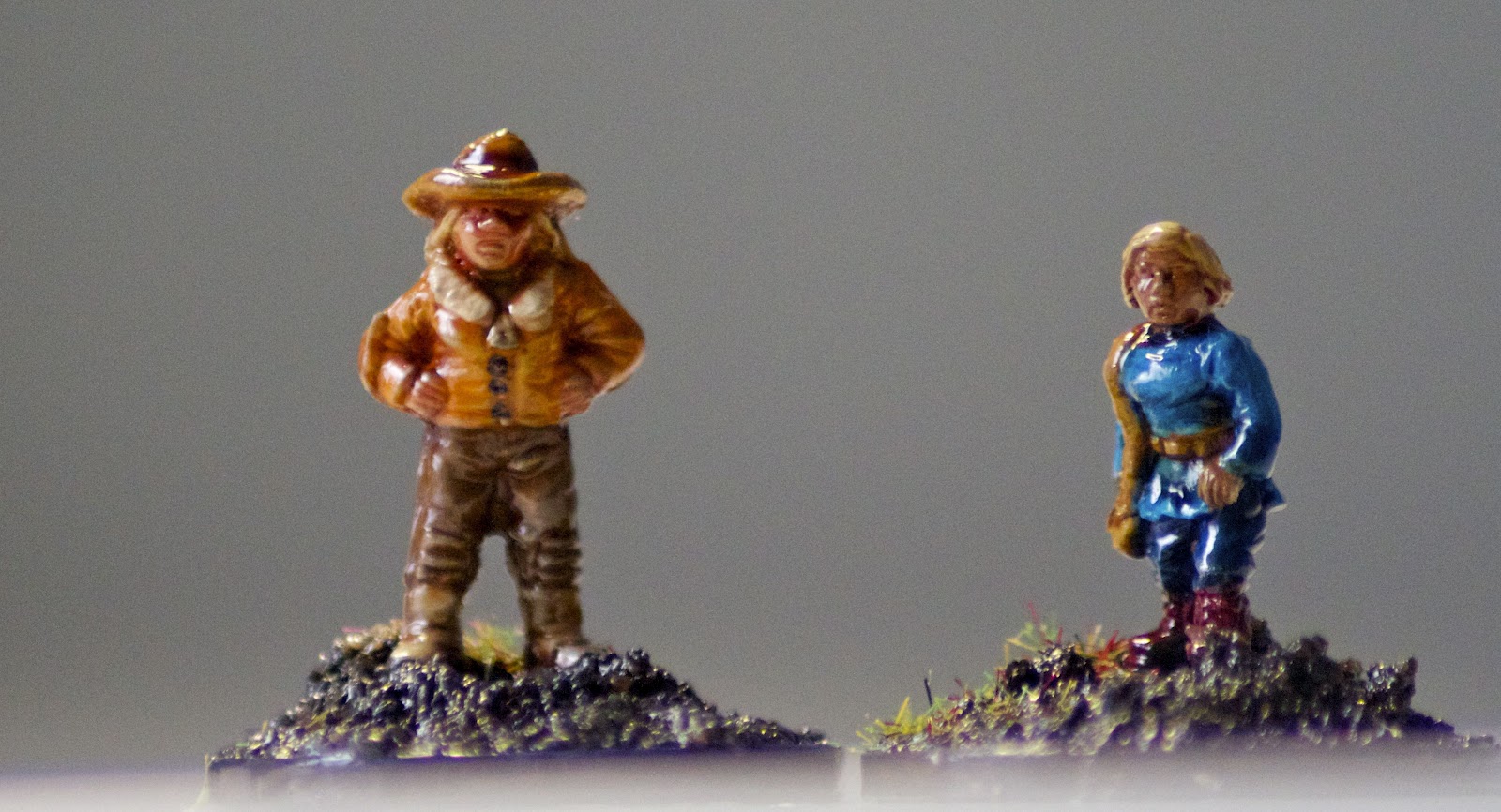
 Claive gauard
(Peter Pig AK47 Professional types)
 ROF section leader encourages his team forward
(GZG New Anglian Marines)
 ROF support team deploying for action
(More GZG goodies)
 Lt. Flode with her command team
(GZG New Anglian Marines)
 Claive Settlers - the ROF will need to try and win them over 
(GZG settlers) 


Wednesday, 28 December 2011

Sytol and the war of unification. Part Three: The Rapid Offensive Force.

The ROF is a Divisional sized outfit, an experienced mercenary force with good knowledge of counter insurgency work and a good battle rating in the War Band Stock Market. The ROF use Battle Groups comprised of Tactical Combat Teams as the basis of a flexible infantry force with organic armoured support. Well trained and equipped, ROF members are volunteers - joining hoping to make some serious cash. 
The core element of ROF outfits is the TCT - the tactical combat team - comprising a small head quarters unit and three fire teams of 8 to 10 soldiers. The fire team are armed with assault rifles, a SAW gunner and usually a missile armed trooper with a team leader and a second in command so that the unit can operate in two teams of 5 (at full strength which is not often). Each fire team has it’s own armoured transport, with the TCT HQ operating out of a mobile command vehicle. The final element of the TCT is the fire support team and reconnaissance team. Three such TCT normally form a battle group under a BG HQ and additional support units such as armour, artillery, air support and the like. Several battle groups as necessary form a combat command and the combat command is the main fighting force that a client will hire for large scale fighting. 
Mission bonuses are shared amongst the teams who undertake a mission, with fully 12% of the contract price going toward this pot. Any additional bonus payments made by the contractor attracted by achievement of specific tasks within a mission (such as the capture of a leader as well as the taking of a geographic location or the destruction of the opposing force) goes straight to the teams involved in the operation. 

Each member of the mission is assessed post completion via the coms links in helmet and armour to ensure they played their part in the campaign. Those deemed to have not participated fully risk losing part of their share or in extreme cases - all of it. The KIA’s have good insurance paid out by the ROF to next of kin or in many cases, to friends or even units within the ROF. A volunteer signs for twelve years. This system of reward creates and encourages success, without the need to create suicidal heroes. Casualties are unavoidable, inevitable and accepted, but are seen in the same light as loss of equipment - expensive and wasteful of profit. The ROF Command is efficient and effective, and the whole war band encourages a sense of esprit more commonly seen in elite regular army forces. There is pride in serving with the ROF. 
Having accepted the contract, ROF intel had little hard data on which to build a tactical plan of action for the upcoming police action. Information on the inward looking Claive was hard to come by, save for a few theological studies some decades before. Because of a tight time frame there was little opportunity to do extensive research and reconnaissance. But then, that is the norm for the ROF, well used to the client mentality of INIDY (I need it done yesterday). Even so, in the days leading up to the first of it’s units crossing the border between Arden and the valley, the ROF intel assessment teams were able to add considerably to the body of work so far compiled on the Claive.

Friday, 23 December 2011

Sytol and the war of unification. Part Two: The Micro Politics and House Arden

Elsewhere, the world turns. The UAP remains in active negotiation with many states, and many states still seek to join. 
One of those states is the the Principality of Arden. Arden is a medium sized state with a stable government and a tradition of survival in Sytol's complex and lethal politics. The ruling house of Arden has reigned unbroken for centuries, and in it’s latest leader, Prince Freklim Arden, has arguably, one of the families greatest strategic thinkers in generations. Arden had begun it’s conversations with the UAP nearly thirty years ago. House Arden always takes the long view, and has built up a network of support and cooperation between other states and long maintained a highly tolerant religious view that has given it stability and plenty of buffer room against potential enemies. Arden was an agricultural economy which slowly developed into a manufacturing and research base which provides wealth and harmony within its borders. For years, the house has sought membership into the UAP at a time of it’s choosing. House Arden has long considered it’s future as a power within Sytol, and has come to terms with the loss of it’s royal status in the future. It has concluded that Sytol's best future is part of the Union. Indeed, members of the royal family have  travelled extensively amongst many planets of the Union which has aided its decision making process. 
But Arden feels it needs to be at the centre of the UAP in the short term (the next two hundred years or so) in order to be able to influence the Sytol government sufficiently well in order to guide the planet to the best outcome. That aim is Union membership but if that fails - it feels it is vital to be sufficiently close to decision making to protect House Arden interests in the future. It cant carry out this mission militarily, it knows that its professional and well equipped force is simply too small for that purpose. But its military command is well trained and highly focused on the survival of House Arden, and it thinks it has found a lever that will elevate Arden into the heart of the UAP decision making process. 
Fully three hundred years ago, Prince Hardlin Gorgot Arden IV allowed a small religious group calling itself The Claive, safe haven in a small, inconsequential holding of the principality. The land was called the Sarl Valley, a narrow strip of fertile land fed by rivers nestled between mountain ranges. To the west lay desert, to the east, the patchwork of city states known collectively as Veldyn. To the North were the wastelands haunted by the clans - the organic sentient alien species known as the Kresh. 
The Sarl Valley was a fertile land, but was a thin strip of civilisation caught between the combined vices of lawless lands. Kresh raids caused constant damage and carnage. The dessert held bandits who regularly raided farms and settlements, and the chaotic Veldyn states often sent warring forces over the passes into the green and pleasant farming lands of Sarl, forcing Arden to maintain large and costly armed forces in the valley out of all proportion to it’s value. 
The Claive settled in the North, in lands mostly depopulated from raids and massacre. It cost Arden nothing to let it settle, but nonetheless the political intelligence of the royal household ensured it retained leverage with the Claive by granting it refuge on a lease basis. 
The Claive was just one of thousands of religious groups - perhaps tens of thousands around the Sytolian world. It is one of the oldest - formed during the great civil war that saw Sytol break apart and fall away from the old Union during the first A’Krian war. They are not an especially unique or unusual sect, seeking enlightenment, but over time they have grown in sophistication and in numbers. As is typical with many similar groups, people joining them sign over all worldly possessions - giving the Claive a regular income and funds. On top of that, the Claive farm and mine in the Sarl, and this provides it with a steady and not inconsiderable income which it re-invests solely into the growth of it’s communities. So unlike very many religious groups, it’s aims are genuinely for the good of its community. 
Over time, the Claive grew. it expanded its settlements, repopulating the Sarl, improved the road network and became a small but successful state of its own - but one only interested in itself. It traded with the outside world, it marketed extensively to attract new members, but otherwise attracted no attention to itself. 
The lease it negotiated with Arden ran out more than forty years ago. Arden would have happily extended the lease but for one little point of geography. The Sarl valley butted alongside lands that gave access to the desserts and the wastelands. Insignificant data. Unless in time of war, access to those wastes in flanking positions became highly valuable...
Arden decided on a policy that tried to dance along a knife edge of political intrigue, gambling for high stakes and influence. If it made too much noise, or acted too rashly, the opportunity for influence would be lost and Arden would have to look for other - as yet unknown opportunities - to gain influence in the UAP. 
Five years ago Arden gave notice to the Claive to quit its legal lands in the Sarl valley. The political council of Arden opined that the Claive would not go, and would endeavor to resist displacement. They were correct. Arden then agreed that the Claive could stay but that the principality would re take full control in the valley, including military and police forces, and the introduction of new colonists from Arden. The Claive refused to countenance such a presence in their sacred valley. 
Arden took their case to the Supreme Court of the UAP, and despite strong and costly legal representation by the Claive, won the right to retake their lands and evict the Claive from the land they had toiled so hard to tame. 
When security elements of Arden arrived at the small hamlet of Jrinn, the southernmost Claive settlement to enforce the eviction, they were fired on. Withdrawing with one trooper wounded, Arden announced it’s outrage, and applied to the Supreme Court for the right to forcibly evict the Claive in line with mandate ZT4709-B. This has been granted, allowing House Arden to enforce its claim militarily. 
Arden’s aim is to take full control of the Sarl Valley. In order to do this, it must clear the Claive of the valley, and it has offered alternative lands for the Calive to settle in. The Claive are of no interest to Arden. They would have happily allowed them to stay in the Sarl forever - they have acted as a highly effective buffer against incursions from the Kresh and other human and non human bandits and raiders - Arden lands have not been invaded for more than a century. But the valley is now of highly significant political leverage for Arden. As it is, the Sarl falls under the mandate - a neutral zone which allows for no UAP forces to enter, no fly over, no military forces. With the Claive gone, the Sarl is legally recognised as part of the Principality of Arden. 
If the UAP were to accept Arden into their family, military forces would be able to use the Sarl to launch potentially war winning flank attacks against the FFA forces in the Black Hills. The chief resistance to the unification process could be overcome in less than five years. This would be worth a great deal to the UAP, and would provide Arden with a priceless bargaining chip for entry into the UAP at level of political influence they could dictate. 
Arden’s chief concern is that their military strategic planning council spotted this potential a decade ago. The fear in the royal inner circle is that sooner or later, military computers on both sides of the front lines will also decipher the Sarl Valley as a rather obvious soft target for either side to exploit. That they have not so far, the planners at Arden command put  down to strategic thinking based on UAP military policy and the mandate. 
Arden must therefore tread wearily and keep publicity of the eviction to a minimum. The greater the news coverage of the events as they unfold, the more chance that a bored intelligence officer in Gaop or the Black Hills will turn their attention to the little known Sarl Valley, look at the maps of the road net available and say “hang on a minute...”
To minimise the chances of publicity, the principality has decided to do what the vast majority of states do in such circumstances. Hire an army to do the dirty work. In this case, one of the best; the Rapid Offensive Force.

Thursday, 22 December 2011

Sytol and the war of unification. Part One: The macro politics

A fledgling world government has been in existence on Sytol for fifty seven years, driven forward by the Union of Active Participants (UAP), a group of nation states, corporate bodies, religious groups, and other governments who came together firstly to draw up the laws and statutes that formed the Sytol supreme court, to be followed by a single currency, and then the dissolution of their own governments and tools of power in favour of the democratic collective of the UAP.

This was driven by a desire to end the incessant and chaotic warfare that had racked Sytol since it's alleged freedom from the Union. The UAP saw that, far from liberating Sytol from the myth of Union slavery; the withdrawal of Union control had led to centuries of bitter and deliberating warfare.  
A powerful smaller group within the UAP, calling itself the Enlightened Collective of Mutuality, were the driving force behind the concept of the war of unification. It realised that the UAP ultimate goal of membership back into the Union would be centuries away given the pace of negotiation and persuasion in the fifty seven years in which the process had been rolled out. UAP members feared that the relative close proximity of the A’Krian Empire threatened Sytol’s existence and certainly its freedom. No one wanted to become a client planet of the A’Krian empire with its cruel battle religion and strict caste system. Whilst it looked increasingly likely that a second A’Krian war would break out between it and the Union, and that the Union would win, in the meantime nothing could prevent an A’Krian wide path impi from rolling up and taking Sytol for the empire, or at best, depopulating the planet to send them all into slavery and worse. 
The collective argued that, in order to progress the process at a faster pace, military action against some states was necessary. Their absorption into the growing UAP would encourage less militant states to join of their own free will. The collective successfully campaigned for this concept of a just war through the instigation of citizenship on Sytol - a process that would reward individuals with freedoms and financial security that many could not dream of. This concept of membership was enhanced by a process of participation and diplomacy with the world government with all states and bodies who ruled. These multi layered conversations where called Tiers and each nation, state, royal household, religious group, free state, corporate holding, syndicate etc was allocated to one of the many tiers depending on how far along the path of accepting the broad concepts of relinquishing control of it’s people, lands, laws, currency and industries it had travelled. 
A voice in the world government was an increasingly useful and valuable political tool - and having an enhanced negotiation level in which to enter the world government and so have increased influence within it was for many states very important. The UAP had realised this early on and encouraged the process. As a state progressed through the Tiers, it gained influence within the UAP and more importantly, restrictions on the UAP itself  allowed these states to avoid invasion and forceable absorption. 
The war of unification became increasingly necessary after it was realised that there was a core of strongly independently minded governments who wanted nothing to do with a unified world, law, currency and freedoms, and who certainly wanted nothing to do with membership of the Union - the ultimate goal of the UAP. After all, Sytol had been one of the worlds in many systems which had rebelled against the old Union to seek its freedom during the first A’Krian war. In order to be able to join the Union the whole planet had to be unanimous in the urge to join. At the current pace of negotiation the UAP came to realise that the Collective’s assertion was correct - that referendum was centuries away unless the pace of unification could be increased drastically. Some states would need to be forced into absorption.  
The UAP began to discuss this process with the Union, who had established an embassy on Sytol some seventeen years ago as recognition of the progress being made by the UAP. Both parties agreed that whilst some sort of military coersion was required to provide a catalyst to the process, it was vital that loss of life of civilian populations, damage to property and infrastructure, and industries would need to be minimal. 
UAP rules of engagement mandate ZT4709-B was thrashed out, which allowed defeated entities to join the UAP without a smashed infrastructure and the need to pay huge compensation for wholesale destruction and loss of life. 
Of course, for the boots on the ground, it made no real difference. Death still came, as did terror and maiming. 
The first target for the UAP was the syndicate lands of Orbom: a useful industrial addition to the UAP and one of the vociferous opponents of the concept of world unity. Six of the UAP donated forces and material to the effort which accomplished it’s mission in eight weeks with minimal damage to the industrial complexes which produced 30% of the weapons used on the central continent. The corporate militia had been no match for the combined arms of the UAP. The board of the syndicate was dissolved and scattered, the share holders compensated, the syndicate workers given citizenship into the new world, the business' that supported the syndicate lands allowed to continue trading. The news channels across Sytol exploded, but the general opinion was positive - Orbom had been considered a particularly parasitical organisation. 
UAP learned many lessons from the short war which had cost it nearly two thousand casualties. The main lesson was that war by committee was highly inefficient and that the disparate armed forces did not gel well during the campaign. 
The collective came up with the answer - the UAP needed it’s own army. The Sytol Guard was born. The first ranks of the Guard were taken from the displaced and disregarded by product of wars and conflicts from across Sytol. Controversially, the Collective suggested the orphaned children of wars from around the world. These children were taken in, given a home, indoctrinated into the dream of world unity, trained by the best forces from the UAP. The collective wanted to buy the best equipment the Union had to offer to arm this fledgling army, but the Union would not allow the trade of arms to non-Union members. Others in the UAP argued that in order to prove itself, the Guard would have to demonstrate its skill in battle with equipment no better and no worse than it’s enemies. 
The Guard started life as a Brigade of three small regiments. It’s members were made full citizens of the UAP with the prospect of a very generous retirement (should they make the 30 year ticket), plus other benefits which made joining the guard attractive to other people across Sytol, and young people began to sign up. But it would take time to build up a force that could take on all comers.
In the meantime, the bulk of the campaigns were undertaken by UAP member forces and by making extensive use of mercenary forces. The first targets were easy - individual city states, principalities and religious groups who fell in isolation. But those who were against the whole concept of a unified world came together and formed a loose confederation under the old banner of the Free Fighting Army - the historic confederation which had freed Sytol from the Union centuries before. This changed everything. 
The FFA had no restrictions on the method of waging war, although it suffered the same problems that had first afflicted the UAP forces - a rag tag, hotch-pot of forces armed in a multitude of ways with varying levels of training and professionalism made waging coherent war difficult. If anything, the FFA faced larger problems with each member state vehemently independently minded. Still, they had momentum on their side and when they launched their spring offensive during the traditional raiding season, they struck hard against the UAP forces and forced them back onto the Gaop ridge - the HQ of UAP central command and seat of the World Government at war. Only the deployment of the fledgling and untried Sytol Guard saved the experiment in unification from total disaster. The now divisional size Guard stemmed the assault and hurled it back across the dessert, back to it’s camps in the Black Hills. The subsequent UAP counter attack was in turn halted in this wild hill land and a stalemate ensued as both sides licked it’s wounds and re-armed and refitted. 
The stalemate has so far lasted three years.